If you are looking up the jaguar man legend, start with this: it is not one story with one origin. “Were-jaguar” (in Spanish, hombre-jaguar) is the name archaeologists gave to Olmec figures, half human and half feline, carved in stone and jade on Mexico’s Gulf Coast around 3,000 years ago. Over time that image blended with the Mesoamerican belief in the nahual, a person who can turn into an animal, and today it circulates in hundreds of popular versions.
So where does Nayarit come in? Here the jaguar is very real: it lives in the Sierra de Vallejo mountains and in the mangroves of Marismas Nacionales, and it shows up in the stories and art of the mountain peoples. But many online tales about a “Nayarit jaguar man” created by the gods have no source at all. This guide separates what is documented from what was made up, and tells you where to find traces of the jaguar in the state.
One correction before we go on: the Náayeri are the Cora people and the Wixaritari (singular Wixárika) are the Huichol people. They are two different peoples.
What the jaguar man legend is: Olmec origins
Mexico’s first feline icon appears among the Olmecs, between 1250 and 400 BCE, in monumental sculptures and small jade pieces from sites such as San Lorenzo and El Azuzul in Veracruz and La Venta in Tabasco. Many show an impossible creature: a human face or body with jaguar features and a drooping upper lip that seems to snarl. Researchers named them were-jaguars.
What they meant is still debated. The three most cited readings, summarized by archaeologist Nicholas J. Saunders in the Mexican journal Arqueología Mexicana, are:
- Supernatural beings born from the union of Olmec rulers and mythical jaguars, a way of giving power a divine origin.
- Shamans mid-transformation: some small figures seem to show a person turning into his feline nahual.
- Priests wearing jaguar masks during a ritual, with no literal transformation.
For decades the were-jaguar was thought to be the main Olmec god. Today it is seen as one of several beings in their religion, often linked to rain and fertility.
The nahual: the person who becomes a jaguar
The second root of the legend is the Nahuatl word nahualli. In 1571 the friar Alonso de Molina translated it as “witch,” “necromancer” and “sorcerer,” and modern dictionaries define it as a specialist with the power to turn into a wild or domestic animal.
The jaguar was among the most powerful animals in that world. Among the Mexica (Aztecs), one aspect of the god Tezcatlipoca was Tepeyóllotl, “heart of the mountain,” shown as a jaguar in codices such as the Codex Ríos. The friars’ reading of the nahual as a witch lives on in many present-day tales.
The layers of the legend, oldest to newest
| Figure | Period and place | What it is | How well documented |
|---|---|---|---|
| Olmec were-jaguar | 1250–400 BCE, Veracruz and Tabasco | Half-human, half-feline figures in stone and jade | Real archaeological pieces; meaning debated |
| Nahual (nahualli) | Mesoamerica; recorded since the 16th century | Specialist who turns into an animal | Colonial dictionaries and ethnography |
| Tepeyóllotl | Mexica, Postclassic | Jaguar aspect of Tezcatlipoca, “heart of the mountain” | 16th-century codices |
| Jaguar in a Wixárika story | Recorded by Carl Lumholtz around 1900 | Night animal that attacks the first Sun | Published ethnography |
| Nayarit “jaguar man” created by the gods | Internet, 21st century | Divine guardian worshipped by a mountain people | No source found |
The jaguar in Nayarit’s cultures: what is actually documented
Nayarit is home to four Indigenous peoples: Cora (Náayeri), Huichol (Wixaritari), Tepehuano (O’dam) and Mexicanero, most of them in the Gran Nayar highlands, in municipalities such as Del Nayar and La Yesca. For the region’s history, read our guide to King Nayar and the peoples of the Gran Nayar.
The Wixaritari: jaguars against the first Sun
The best-documented jaguar story we found is Wixárika. It was recorded by Norwegian explorer Carl Lumholtz, who traveled the Sierra Madre Occidental in the late 1800s and published Unknown Mexico in 1902. Anthropologist Johannes Neurath, curator of the Gran Nayar hall at Mexico’s National Museum of Anthropology, opens his monograph Huicholes (2003) with it. In short:
- At the beginning of time there was only moonlight. The elders asked the Moon to send them her only son, a boy who was lame and blind in one eye.
- They dressed him for ceremony, with bow and arrows, and threw him into an oven. The boy came back to life, ran beneath the earth and, five days later, rose as the Sun.
- When the Sun lit up the earth, the night animals (jaguars, pumas, wolves, coyotes, foxes and snakes) grew angry and shot arrows at it. Its light blinded them and drove them into caves, pools and trees.
- Only the squirrel and the woodpecker defended the Sun on its first journey. The jaguars and wolves killed them, which is why the Huichol honor those heroes and call the squirrel “Father.”
Notice the jaguar’s role: it is not the kindly guardian of the online versions but a force of the night that resists the light. It is a single story from over a century ago, and Wixárika mythology varies between communities: don’t read it as “the” Huichol view of the jaguar. For the wider picture, read about Tatei Haramara and the Wixárika origin of the world and the symbols of the Wixárika worldview.
The jaguar in Wixárika beadwork
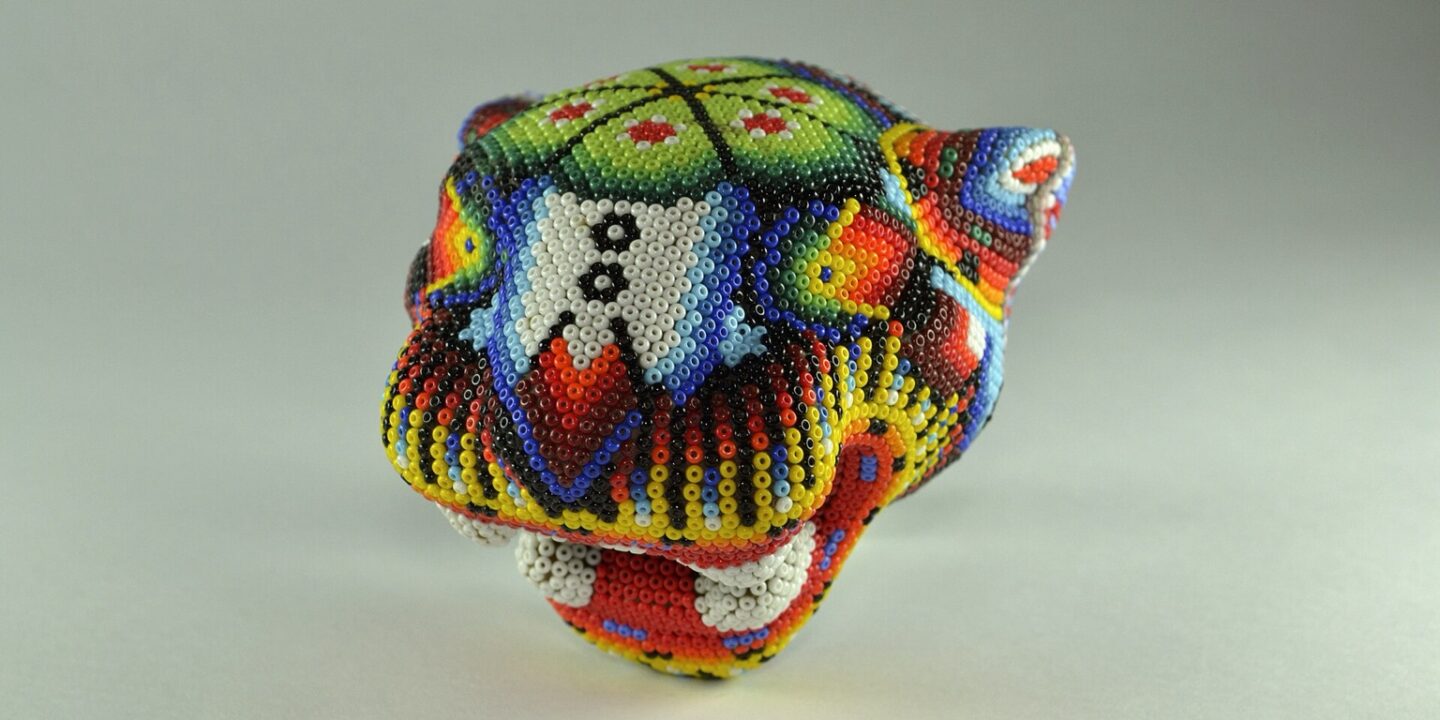
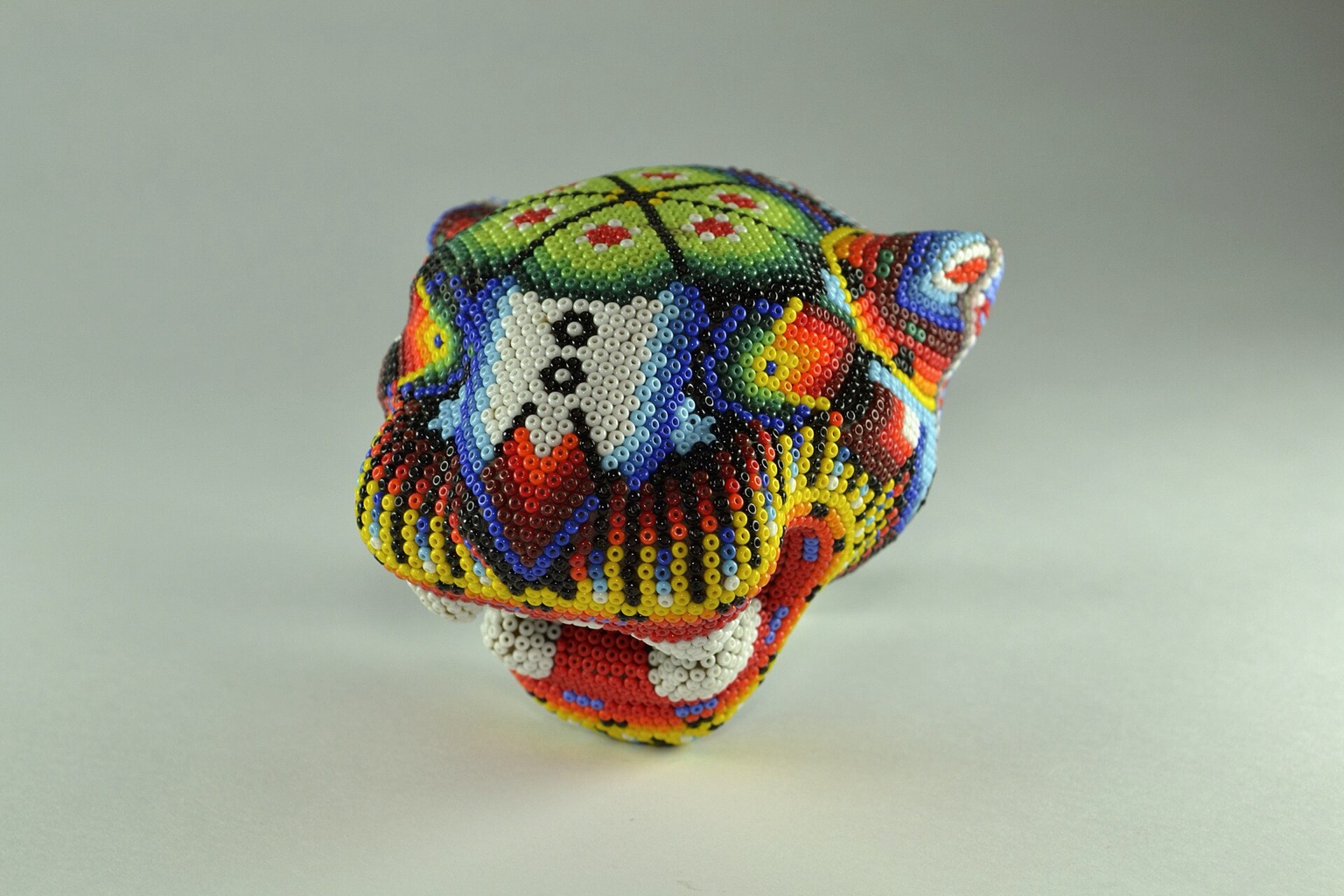
Walk through downtown Tepic or the shops of Riviera Nayarit and you will see jaguar heads covered in chaquira: glass beads pressed one by one into wax over a wooden or papier-mâché base. Artists often add motifs such as peyote, deer, corn or flowers. It is one of the most popular forms of contemporary Wixárika art, and much of it is made for sale.
Be careful with labels: lines like “the jaguar is the messenger of the gods” or “the shaman’s protector” are usually shop copy, not ethnography. If you want to know what a piece means, ask the person who made it. Just as with the ojo de dios (God’s eye), their explanation is worth more than any tag.
Cora, Tepehuano and Mexicanero peoples
For the Cora we found no reliable ethnographic source describing a jaguar man myth, or any role for the jaguar in La Judea, the Cora Holy Week in Jesús María, whose main characters are the painted “Jews” who hunt down Christ. If you read otherwise, ask for the source. The same goes for the Tepehuano and Mexicanero peoples.
The “Tiger of Álica”
Across much of Mexico the jaguar is called tigre, and Nayarit’s most famous use of the nickname belongs to Manuel Lozada, “el Tigre de Álica,” who led a 19th-century mountain movement with Cora, Huichol, Tepehuano and mestizo followers (1856–1873). It is a nickname, not a shapeshifting myth, but it shows the weight the “tiger” carries as a symbol of strength.
The real jaguar: where it lives in Nayarit today
The jaguar (Panthera onca) is the largest cat in the Americas and is listed as endangered under Mexico’s NOM-059-SEMARNAT-2010 standard. Nayarit holds two of its most important refuges on Mexico’s Pacific coast.
Marismas Nacionales
The Marismas Nacionales Nayarit Biosphere Reserve, decreed in 2010, covers mangroves and coastal lagoons in Acaponeta, Rosamorada, Santiago Ixcuintla, Tecuala and Tuxpan. Using camera traps, Mexico’s protected areas agency CONANP estimated in 2016 a population of at least 22 jaguars, at a density of 2 to 4 per 100 km² (39 sq mi), and confirmed they breed there because cubs appear every year. Bobcats and ocelots were recorded in the same area.
On the private La Papalota conservation area in Santiago Ixcuintla, researchers identified 15 different jaguars between 2015 and 2020. GPS collars fitted in 2020 showed the cats spend 60 to 80 percent of their time outside protected areas, on communal and private ranch land, so their future depends on landowners as much as on the reserve.
Sierra de Vallejo-Río Ameca
This is the forested range you see behind the Riviera Nayarit coast. It was declared a federal Biosphere Reserve on January 8, 2024, covering 225,398 hectares (about 557,000 acres) in Bahía de Banderas and Compostela in Nayarit and four municipalities in Jalisco. It protects pine-oak and cloud forest plus tropical forest, and shelters jaguars and pumas within a biological corridor that lets them move between the mountains and the coast.
Can you see a jaguar in Nayarit?
Almost certainly not: jaguars are nocturnal, avoid people, and nearly everything known about them comes from camera traps and collars. What you can do is explore their habitat with local guides, go birding in the mangroves and never feed wildlife. Find ideas in our guide to ecotourism in Nayarit.
Where to find traces of the jaguar in Nayarit
| Place | What you’ll see | Practical info (2026) |
|---|---|---|
| Museo Regional de Nayarit (INAH), Av. México Norte 91, Tepic | The state’s archaeology: reconstructed shaft tombs, the Aztatlán tradition, urns from the Matatipac valley | Tue–Fri 10:00–19:00, Sat–Sun 10:00–15:00; approx. $145 MXN for foreign visitors and $80 MXN for Mexican nationals (approx. 8 / 4.5 USD) |
| Museo Casa de los Cuatro Pueblos, Calle Hidalgo 60 Oriente, Tepic | Folk art of the Cora, Huichol, Tepehuano and Mexicanero peoples: beadwork, textiles, gourds | Check opening hours before you go |
| Downtown Tepic | Wixárika artists selling beadwork, sometimes jaguars | Ask who made the piece and which community they are from |
| Marismas Nacionales | Mangroves and lagoons, jaguar habitat | Birds almost guaranteed; jaguars almost never |
The Museo Regional is an archaeology museum: don’t expect a jaguar gallery, but rather the background of western Mexico’s ancient cultures. Check hours and fees on the official INAH page. To plan the day, use our guide to Tepic in one day or our Tepic page.
Frequently asked questions
What is the jaguar man legend?
It is the Mesoamerican idea of a being that is half human and half jaguar, or of a person who turns into a jaguar. Its oldest image is in Olmec figures from 1250–400 BCE; later it merged with the belief in the nahual.
Is the jaguar man a Nayarit legend?
Not originally: it is Olmec and Mesoamerican. In Nayarit there is a documented Wixárika story in which jaguars, as night animals, attack the first Sun, but no jaguar man specific to the region.
What is a jaguar nahual?
Nahualli is a Nahuatl word for a specialist able to turn into an animal. A jaguar nahual would take the form of that cat; 16th-century friars translated the word as “witch.”
What does the jaguar mean to the Huichol?
In the story recorded by Lumholtz, the jaguar is a night animal that opposes the newborn Sun. Today it is also a common motif in Wixárika beadwork, and its meaning varies from artist to artist.
Are there jaguars in Nayarit?
Yes. They live in Marismas Nacionales, where CONANP estimated at least 22 animals, and in the Sierra de Vallejo-Río Ameca reserve. They are endangered under Mexican law and very rarely seen.
Where can I see jaguar art in Tepic?
With the Wixárika artists in downtown Tepic and at the Museo Casa de los Cuatro Pueblos. The Museo Regional de Nayarit covers the state’s archaeology.
Area map
- 1Nayarit Regional Museum INAH museum at Av. México Norte 91, Tepic: the state's archaeology.21.51, -104.8926 · Open in Google Maps